
If I were Jon Stewart, I’d be really annoyed right now.
Jon Stewart popularized the concept of fake news. He wasn’t the first or the last. The Onion, Saturday Night Live and Greg Kilborn came before him. Stephen Colbert, John Oliver, Trevor Noah and Seth Myers followed him. But we all know the crown belongs to Stewart.
Lately we have been hearing about fake news a lot, and the term has been given a pretty significant twist. What Stewart presented as fake news is satire. Today, the term has come to mean one of two things. The first is the deliberate creation of false stories placed on social media as news. The second is labeling a true news story as fake because someone disagrees with it.
The latter was on full display at a press conference when President Trump told a CNN reporter that he wouldn’t allow him to ask a question on a topic because CNN was fake news.
Strife between politicians and the media is not new. President Obama did not welcome the press with open arms. Sarah Palin made famous the term lamestream media. Richard Nixon will forever be tied to his nemeses, Woodward and Bernstein. However, it’s one thing to disagree with or even avoid talking to the press. It’s another to attempt to marginalize it. Dismissing a legitimate, national news organization as fake, the way the president has, and calling the media the opposition, as Senior Advisor Steve Bannon has, goes far beyond anything we’ve seen before.
It’s hard not to perceive these comments as part of a campaign to discredit the media. While such a strategy may be politically expedient (public opinion of the media has been at an all-time low), it is misguided when it comes to the long-term health of our nation. And when we the people buy into the strategy, we hurt ourselves. The media are not in opposition to the people. They represent us. They are our eyes and ears. They’re the ones in the room when we cannot be.
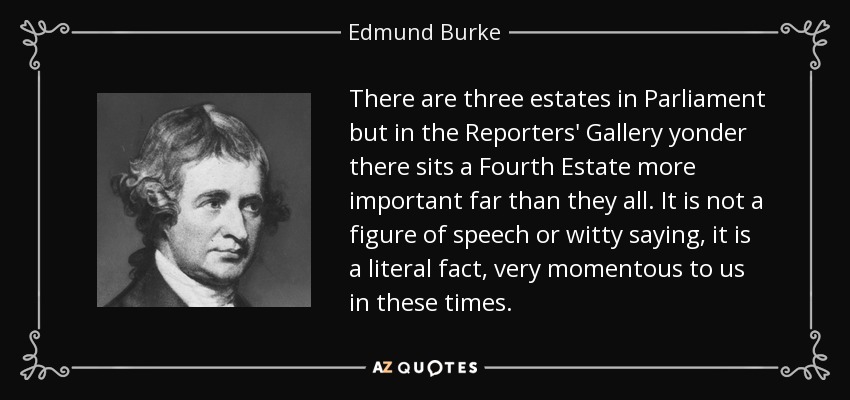
Eighteenth Century British Member of Parliament Edmund Burke is credited with coining the term the Fourth Estate. Parliament was made up of three estates: nobles, clergy and commoners. The Fourth Estate was the media. Source: Thomas Carlyle in On Heroes, Hero Worship, and the Heroic in History.
Don’t get me wrong, I’m not blind to the institution’s flaws. I often don’t recognize the journalism of my professors who were so committed to objectivity they cautioned us against using words like “claimed” instead of “said” because claimed was subjective. During my days as a corporate spokesperson, I don’t think I was ever quoted completely accurately by a news organization. With cable news networks intentionally carving out liberal or conservative audiences, and not always drawing a clear line between news and commentary, it’s understandable credibility is low.
Still, with all its problems, a robust press with access to our elected officials is central to a free society. If we value that freedom, we have to do more than barely tolerate the media. We have to protect it. No, that doesn’t mean blanket acceptance. In fact, I think it means the opposite. We need to critically assess our sources of information and make sure we are using them intelligently.
What should we look for when deciding the credibility of a news source? Traditional news organizations, whether print (paper or digital) or television’s nightly news programs, have their own separation of powers. News, the objective presentation of facts, is separate from editorial. Editorial, the opinion of the news organization’s editors and others, is separate from advertising. Advertising, no matter how much a company might pay for space to sell its message, does not dictate how that company is covered in the news section.
Cable television is trickier. There is so much commentary that the separation can be more difficult to distinguish. The important thing here is to make sure we know if the person speaking is an objective anchor, an opinion-driven host, an analyst providing conclusions based on facts and expertise or a commentator who is paid to present a particular point of view.
And then, of course, there’s social media. All I can say is, buyer beware. Treat anything you read as suspect until you can check it out with a source you trust. Like advertising, social media is one sided. I heard a woman being interviewed on CNN say that President Trump should continue to use Twitter because he could bypass the media. That’s not a positive. The news media’s job is to question, push back, dig deeper. The media vets the information.

And we vet the media. It is up to us to know the source of the information we take in, understand the agenda, differentiate between news and opinion. Yes, it sounds a lot like homework. But it’s worth it.
One more thing—can we please stop redefining the language? We are not living in a post-fact culture. There is no such thing as alternative facts. Fact is fact. News is news. Simply because someone doesn’t like the news, doesn’t mean it is fake. And deception has no business masquerading as reality.
Which brings me back to Jon Stewart. A key distinction between his use of fake news and the way the term has been co-opted is that, with Stewart, the audience is in on the joke. Arrived at through the skillful use of the tools of satire—mockery, hyperbole, slapstick, drama, the sacred and the profane—the end product of Stewart’s fake news is truth.
We need a strong press. It has nothing to do with liking the media. It’s about protecting our freedoms. So let’s be alert and informed. Let’s consider the source. And let’s return the term fake news to Jon Stewart and company, professionals who know how to handle it.
 Bumps, Scrapes and Kisses
Another inspiring post Elaine. All this is happening at a time when the news media are still struggling with the switch from print to digital. It’s hard to imagine that they could have been undermined in this way when we all still paid an army of investigative journalists, political analysts and foreign correspondents by buying a news paper each day. Perhaps now is the time I should take out that on line subscription to the New York Times.
LikeLike